21 Frontiers & Open Problems
“Any sufficiently advanced technology is indistinguishable from magic.”
— Arthur C. Clarke (Clarke’s Third Law)
After this chapter you will have a map of where agent research is heading and the hard problems that remain.
21.1 Capable, but far from solved
We have come a long way. This book began with a single language model that could only produce text, and step by step we gave it tools, memory, reasoning, orchestration, teammates, evaluation, observability, guardrails, and a path into production and the wider world. It is worth pausing, at the end, to hold two truths at once: today’s agents are genuinely capable, capable enough to write code, research questions, and automate real work, and they are far from solved. Both halves matter, and mistaking either for the whole leads you astray.
The honest way to picture the current moment is by analogy to an earlier technology at a similar stage. The self-driving car of a decade ago could cruise a clear highway impressively well and then be defeated by a construction cone or a light snowfall: dazzling in the demo, brittle at the edges, and a long, hard road from “works in the good case” to “trustworthy everywhere.” Agents are at that same adolescent stage: they shine on the happy path and stumble on the long tail, they can be brilliant and unreliable in the same afternoon. Recognizing this is not pessimism; it is the prerequisite for working on what comes next. This final chapter is a map of that frontier: the problems still unsolved, the directions the field is moving, and the responsibilities that come with building this technology. Consider Figure 21.1 its legend.
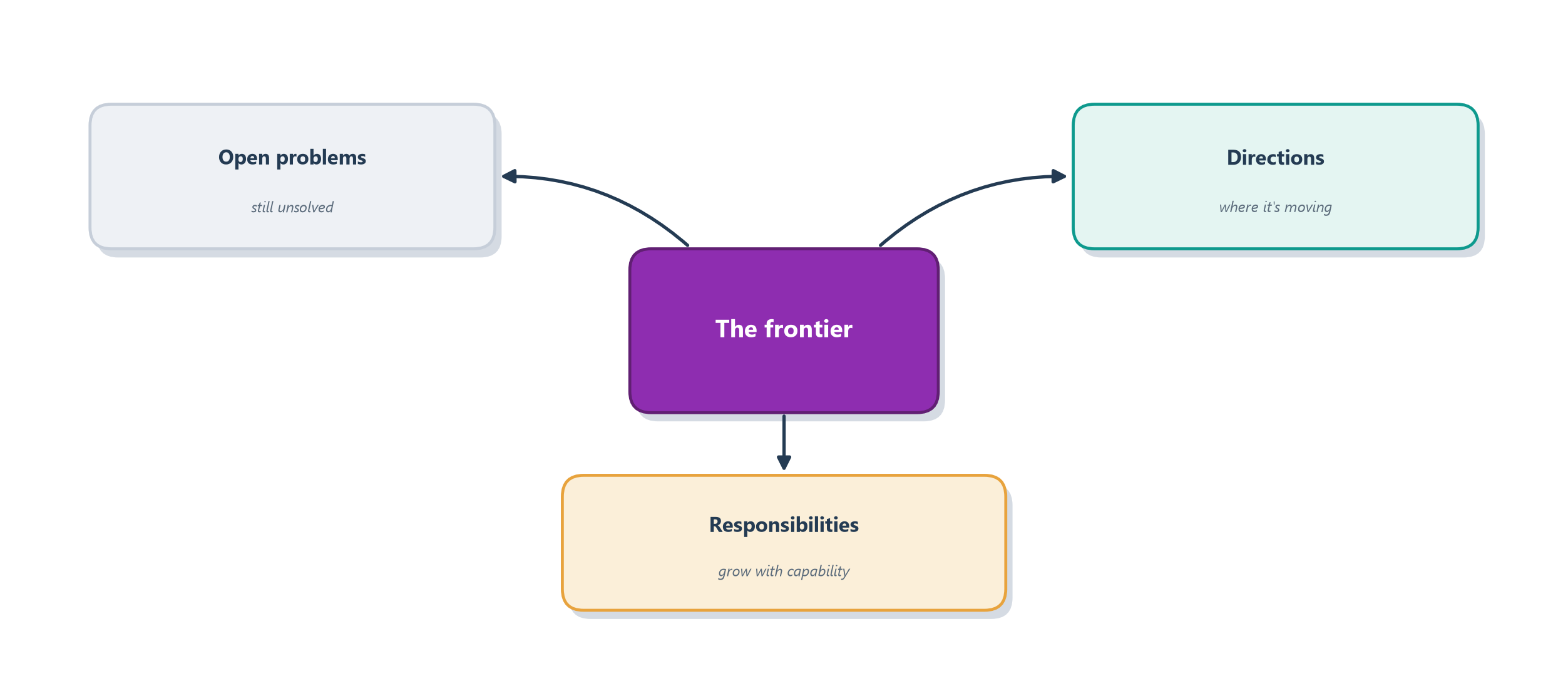
The thread that has run through every chapter, start simple, add capability only when the problem earns it, and stay honest about limits, is exactly the thread we need to follow one last time as we look ahead. So let us begin where any honest map of a frontier must: with the territory not yet charted, the problems that remain genuinely open.
21.2 The problems that remain open
A mature field is defined not only by what it has solved but by how clearly it can state what it has not. For agents, several problems remain genuinely open, not engineering details to be tidied up, but deep challenges that current approaches only partly address [1]. Reassuringly, each one is a familiar friend: every open problem is the unfinished edge of a capability we spent a chapter building. Five stand out, and the subsections below take them in turn before Table 21.1 ties each back to the chapter that laid its foundation.
21.2.1 Long-horizon reliability
The first open problem is long-horizon reliability, the compounding-error problem from Chapter 9, unsolved at scale. Agents can chain a handful of steps well but still lose their way across the hundreds of steps a truly complex, days-long task demands, because small errors accumulate faster than agents can recover from them. There is a striking way to measure this. METR tracks the length of task, measured by how long it takes a human professional, that a frontier agent can finish with 50 percent reliability, and finds that this horizon has been doubling roughly every seven months for six years, yet today’s best models still complete tasks of only a few minutes reliably: nearly 100 percent success on tasks under four minutes, but under 10 percent on tasks that take a human more than about four hours [2]. The trend is fast and the absolute level is still low, which is exactly why long-horizon reliability is the frontier’s defining bottleneck.
Benchmarks built from real work tell the same story from the other direction. TheAgentCompany drops agents into a simulated software firm where finishing a job means browsing internal sites, writing code, running programs, and messaging coworkers; the strongest agent completes only about 30 percent of these tasks on its own, and the ones it fails are precisely the long, interdependent ones [3]. SWE-Bench Pro pushes the same probe into professional software engineering, with 1,865 human-verified problems that often span several files and would take a professional hours to days, and finds today’s agents still far from solving them reliably [4]. The pattern is consistent across both: agents shine in short demos and stumble on the sustained, connected work that actually fills a workday. Reliability at that scale is not one smarter model away; it will take better decomposition, state tracking, verification, and recovery working together.
21.2.2 Continual learning and self-improvement
The second is continual learning and self-improvement: today’s agents do not truly learn from experience once deployed, because the model’s weights are frozen. Voyager’s growing skill library (Section 20.4) is a clever workaround, since the learning is stored outside the model in retrievable code, but an agent that genuinely gets better at its job the way a person does, updating its own understanding from what it sees, remains a research frontier rather than a shipping feature. The difficulty is not just engineering: the underlying obstacle is catastrophic forgetting, the long-known phenomenon that training a neural network on new data tends to overwrite what it already knew, so naive fine-tuning of a live agent on yesterday’s mistakes risks losing yesterday’s competence [5], [6]. Techniques such as elastic weight consolidation, replay buffers, and adapter-based continual finetuning ease the problem in narrow settings but do not yet give us an agent that safely rewrites its own weights on the job.
21.2.3 Memory at scale
The third is memory at scale. The systems of Chapter 12 work well for a conversation or a session, but keeping useful memory over months or years, without it decaying into noise, staleness, or outright contradiction, is unsolved. A human forgets gracefully and reconciles new facts with old; an agent’s long-term store tends to accumulate cruft until retrieval surfaces something wrong. Durable, self-curating memory is still an open design problem.
21.2.4 Evaluation
The fourth is evaluation itself, the honest admission from Chapter 16 that we still lack robust ways to measure open-ended agent quality. You cannot reliably improve what you cannot reliably measure, and for tasks with no single right answer, even defining success is hard. Part of the difficulty is that our yardsticks themselves wear out: popular benchmarks saturate as models catch up, leak into training data and lose their power to tell systems apart, and often measure something narrower than the capability we actually care about, the gap between a test score and genuine competence that researchers call construct validity. Newer efforts answer by designing for contamination resistance, as SWE-Bench Pro does by holding out private repositories so an agent cannot have memorized the answers [4]. Better evaluation is therefore not a side quest but a precondition for progress on every other problem on this list.
21.2.5 Alignment and governance
The fifth, and weightiest, is alignment and governance: ensuring that increasingly autonomous agents pursue the goals we actually intend, safely. This is the concern of Chapter 18 scaled up to systems of real power, where a subtle misunderstanding of intent, multiplied by autonomy and real-world tools, stops being a bug report and becomes a genuine harm. Table 21.1 ties each of these five to the chapter that introduced its foundation.
| Open problem | What’s still hard | Foundation laid in |
|---|---|---|
| Long-horizon reliability | Errors compound over very long tasks | Chapter 9 |
| Continual learning | Frozen weights; no true learning post-deployment | Section 20.4 |
| Memory at scale | Useful recall over months without decay | Chapter 12 |
| Evaluation | Measuring open-ended quality robustly | Chapter 16 |
| Alignment & governance | Autonomy that stays aligned with intent | Chapter 18 |
The encouraging way to read that table is that you are not a spectator to these problems but equipped to work on them: every one sits directly atop machinery you now understand from the inside. These are the questions the field is actively wrestling with, which naturally raises the question of how, and where the momentum is carrying us next.
21.3 Where the field is heading
Predicting the future of a fast-moving field is a good way to look foolish in hindsight, so rather than forecast specific breakthroughs, it is safer and more useful to name the directions where momentum is clearly building. The instructive parallel is the early internet: progress accelerated not from one invention but from the moment shared standards like TCP/IP and HTTP let everyone build on the same foundation, and an ecosystem exploded on top. Agents are in that standards-forming phase now, and three currents are worth watching.
21.3.1 Standardization and interoperability
The first current is standardization and interoperability. The Model Context Protocol of Chapter 11 is the clearest example, a common way for agents to connect to tools and data that, if it takes hold, turns today’s bespoke integrations into a plug-and-play ecosystem, the “USB-C moment” maturing into an actual marketplace of interoperable parts. Standards are unglamorous, but they are usually what tips a promising technology from artisanal to ubiquitous, because they let each builder stand on everyone else’s work instead of rebuilding the same connectors. MCP standardises the agent-to-tool edge, but the harder frontier is the agent-to-agent edge: Google’s A2A (Agent2Agent) protocol, IBM’s ACP, and related efforts propose common wire formats for agents built by different vendors to negotiate, delegate, and share results across organisational boundaries [7]. If MCP is the USB-C of tool use, A2A and its peers are the beginnings of an interoperable agentic web, and the same standards-driven acceleration that let HTTP unlock the document web could unlock multi-agent workflows that today cannot cross a vendor line.
21.3.2 Stronger reasoning at the core
The second current is stronger reasoning at the core. Much of an agent’s competence is inherited from the reasoning ability of the model beneath it, which we examined in Chapter 6 and Chapter 8. As models are increasingly trained specifically to reason and plan over many steps, every agent built on them inherits the lift without changing its architecture. This is why the same scaffolding that struggled a year ago can suddenly succeed on a new model: the loop did not change, the reasoner inside it did.
21.3.3 Better tooling and infrastructure
The third current is better tooling and infrastructure. The frameworks of Chapter 13 and Chapter 14, and the evaluation and observability platforms of Part 4, are maturing from research code into dependable engineering foundations, which is exactly what lets a technology move from labs into production at scale. As these foundations harden, building a serious agent starts to feel less like a science experiment and more like ordinary software engineering, which is precisely the sign of a field growing up.
Notice that none of these is a promise of artificial general intelligence or any particular dramatic leap; they are the unglamorous, compounding improvements, better standards, better models, better tools, that actually move a field forward. That measured framing matters, because the more capable agents become along these axes, the more urgent the question we have deferred to last: not what agents can do, but what we should let them do.
21.4 A responsible outlook
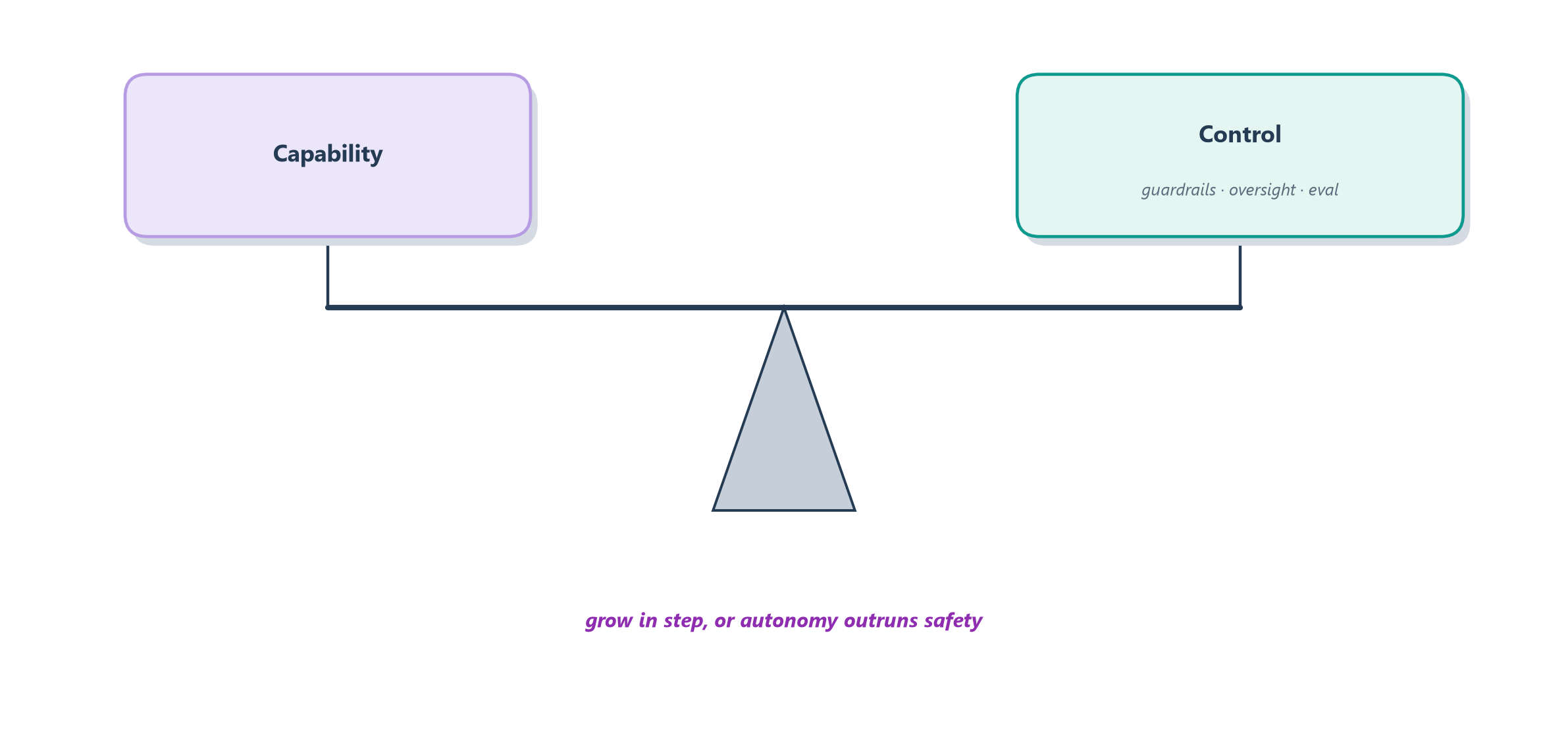
Every chapter of this book has, in its own way, been about a single balance: the tension between capability and control. We gave agents the power to act, and then, with guardrails, oversight, evaluation, and observability, we worked to keep that power accountable. As agents grow more capable, that balance does not become less important; it becomes the whole game.
That balance is now being written into law and into industry commitments. The EU AI Act, which entered into force in August 2024, sorts AI systems into four risk tiers, from unacceptable risk (banned uses like social scoring) through high risk (systems in employment, credit, critical infrastructure, and law enforcement, subject to conformity assessments, logging, and human oversight requirements), down to limited and minimal risk; general-purpose AI models get their own transparency and, above a compute threshold, systemic-risk obligations that phased in through 2025 and 2026 [8]. On the industry side, Anthropic’s Responsible Scaling Policy (RSP) commits the lab to a ladder of AI Safety Levels (ASL-1, ASL-2, ASL-3, …), each unlocked only after specific safety and security evaluations have been passed and matched by deployment-time containment; other frontier labs have adopted comparable preparedness or responsible-scaling frameworks [9]. The US NIST AI Risk Management Framework contributes a common vocabulary for govern, map, measure, manage that both regulators and builders can point to [10]. The right way to feel the stakes is that these are not abstract debates: they are the beginning of the shared rulebook that determines what an agent built today is allowed to do tomorrow.
The failure mode to fear is not capability itself but capability that outruns control: an agent powerful enough to cause real harm, wired without the checks to prevent it. Figure 21.2 draws the balance the rest of this book has been quietly maintaining: as the left pan of capability grows heavier, the right pan of control must grow with it, or the whole thing tips.
This is not an abstract worry; it lands as concrete responsibility on the people who build these systems. It means matching an agent’s autonomy to the stakes of its task, the discipline of Section 6.6 and the oversight spectrum of Section 18.4, and asking, before reaching for autonomy at all, whether the problem genuinely earned it [11]. It means being honest about societal impact: agents will reshape work, and someone must remain accountable when an autonomous system acts in the world, because accountability cannot itself be automated away. The engineer who internalizes this, who reaches for the simplest thing that works, adds power only when the problem demands it, and never lets capability outrun control, is exactly the responsible builder this technology needs. That, more than any single technique, is the durable lesson worth carrying out of this book.
21.5 Summary
This chapter mapped the frontier: the problems still open, the directions the field is moving, and the responsibility that must grow alongside capability.
- Today’s agents are capable but far from solved, brilliant on the happy path, brittle on the long tail, like self-driving cars a decade ago.
- Five problems remain genuinely open: long-horizon reliability, continual learning and self-improvement, memory at scale, evaluation, and alignment and governance. Each is the unfinished edge of a capability built earlier in this book.
- The field’s momentum runs along three durable currents: standardization (protocols like MCP for tools and A2A for agent-to-agent interop), stronger reasoning in the underlying models, and better tooling and infrastructure, steady compounding progress, not a single dramatic leap.
- The defining challenge is the balance between capability and control: as agents grow more powerful, the guardrails, oversight, and accountability around them must grow in step.
- The durable lesson: reach for the simplest thing that works, add power only when the problem earns it, and never let capability outrun control.
21.5.1 A closing word
We end where we began, but you see it differently now. In Chapter 6 an agent was little more than a language model that could produce text. Across Part 2 we turned that model into a reasoner, gave it tools and memory, and taught it to plan. In Part 3 we drew the line between workflows and agents, learned the patterns that tame complexity, and built real systems with LangGraph, the OpenAI Agents SDK, and multiple cooperating agents. In Part 4 we did the unglamorous, essential work of making those systems trustworthy, evaluating them, observing them, guarding them, and deploying them at cost. And in Part 5 we watched agents step off the screen and into the world, and stood, finally, at the edge of what is known.
The throughline of every one of those chapters was a single piece of judgment: start simple, and add capability only when the problem earns it. That principle is what separates a demo from a system, and it is the most durable thing you can carry forward, because it will still be true long after any particular model or framework in these pages has been replaced.
The frontier in this chapter is not a wall marking where the subject ends; it is a shoreline marking where your work begins. You now understand agents from the inside, from a single token of reasoning to a fleet of cooperating systems, and the open problems on that shore are not spectator sports but invitations. Go build carefully, measure honestly, and keep capability and control rising together. The next chapter of this story is yours to write.